Coral Reef Research
Habitat Requirements and Connectivity for Reef Fishes in the Gulf of Mexico
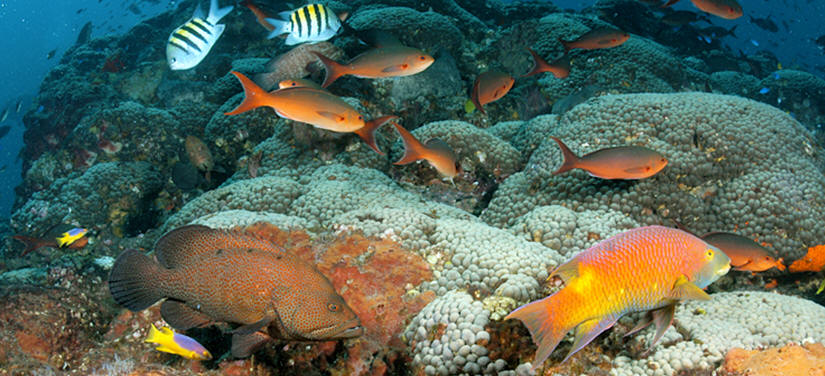
This project will study a wide range of key reef-associated fishes to determine how they utilize the reefs and banks of Flower Garden Banks National Marine Sanctuary and surrounding areas. Using acoustic and satellite telemetry to track fish movement, bioacoustics to capture fish vocalizations, and biophysical modeling to determine larval dispersal, this project will evaluate the habitat use and ecological connectivity of native and invasive mesopredators, foundational reef fishes, and demersal/pelagic fishes that from aggregations. This research will focus on understanding how fish populations use Flower Garden Banks National Marine Sanctuary to improve protected area design and management. We will work closely with resource managers to translate our results in order to effectively protect vulnerable habitats and species that depend on these banks for their survival. The project is led by Dr. Jay Rooker and represents a collaboration of five different universities (Texas A&M University, Louisiana State University, Mississippi State University, University of Florida, and University of Texas-Rio Grande Valley), NOAA’s Flower Garden Banks National Marine Sanctuary, and NOAA’s Southeast Fisheries Science Center. Funding: NOAA’s National Centers for Coastal Ocean Science Image credit: NOAA/FGBNMS.
Associated Publications
Sanchez PJ, Dance MA, Kraus RT, Hill RL, Rooker JR (2023) Fish community characterization of mid-shelf and shelf-edge mesophotic coral ecosystems in the expanded Flower Garden Banks National Marine Sanctuary. Bulletin of Marine Science 99. doi.org/10.5243/bms.2022.0014
Blakeway RD, Fogg AQ, Johnston MA, Rooker JR, Jones GA (2022) Population and demographic parameters of lionfish in the Flower Garden Banks National Marine Sanctuary, northwestern Gulf of Mexico. Frontiers in Marine Science. doi.org/10.3389/fmars.2022.774407
Characterization of fish assemblages associated with high diversity and low diversity coral reefs in the northwestern Gulf of Mexico
The majority of benthic habitat in the northwestern Gulf of Mexico (GOM) consists of soft-bottom sand, silt, and clay substrate, and it is likely that natural banks in the region represent a critical habitat for corals, as well as reef fishes requiring hard-bottom structure. Despite this, the resident fish assemblages associated with many of these features have not been thoroughly studied, and the relative importance of different bank types (i.e. high diversity coral reefs vs. low diversity coral reefs) as essential habitat for reef fish has never been quantified. Efforts to characterize reef fish communities at high diversity coral reefs (East and West Flower Garden Banks) and artificial production platforms in the northwestern GOM began in 1997 with visual surveys on SCUBA, and these were expanded in 2005-2006 to include two low diversity coral reef sites (McGrail Bank and Sonnier Bank) as well as ROV surveys of deeper reef habitats. More recent research has focused on comparing the community and trophic structure of reef fish assemblages associated with low diversity and high diversity coral reef habitats, as well as characterizing seasonal and cross-shelf patterns of recruitment to both reef types in an effort to improve our understanding of metapopulation dynamics within the GOM continental shelf reef system. To directly assess the relative nursery value of high diversity coral reefs, low diversity coral reefs, and artificial structures (i.e. production platforms) in the region, we are also in the process of analyzing dietary composition (stomach content analysis and tissue stable isotopes), growth rates (otolith microstructure analysis), and nutritional condition (RNA:DNA) for two model species of juvenile grouper collected from each habitat type in 2009 and 2010.
Associated Publications
Sanchez PJ, Zapp Sluis M, Pinsky J, Rooker JR (2022) Population structure and regional connectivity of snowy grouper Hyporthodus niveatus in the Gulf of Mexico and western Atlantic Ocean. Marine and Coastal Fisheries 14:2. doi.org/10.1002/mcf2.10199
Dance MA, Rooker JR, Kline RJ, Quigg A, Stunz GR, Wells RJD, Lara K, Lee JM, Suarez B* (2021) Importance of low-relief nursery habitat for reef fishes. Ecosphere 12: e03542. doi:10.1002/ecs2.3542
Habitat connectivity of parrotfish at Hawaiian coral reefs
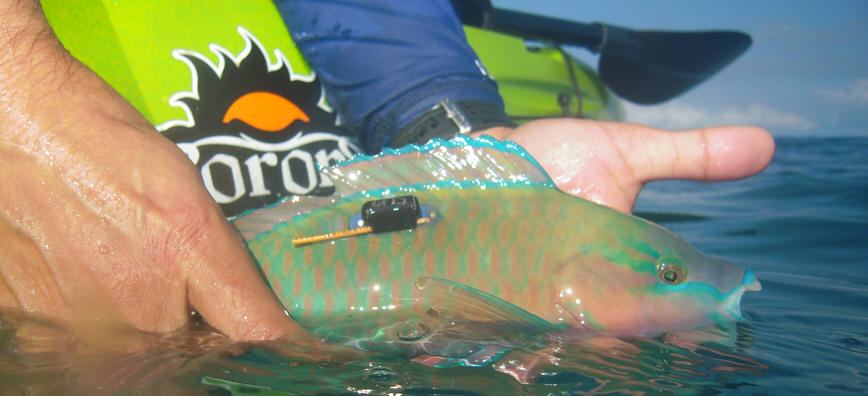
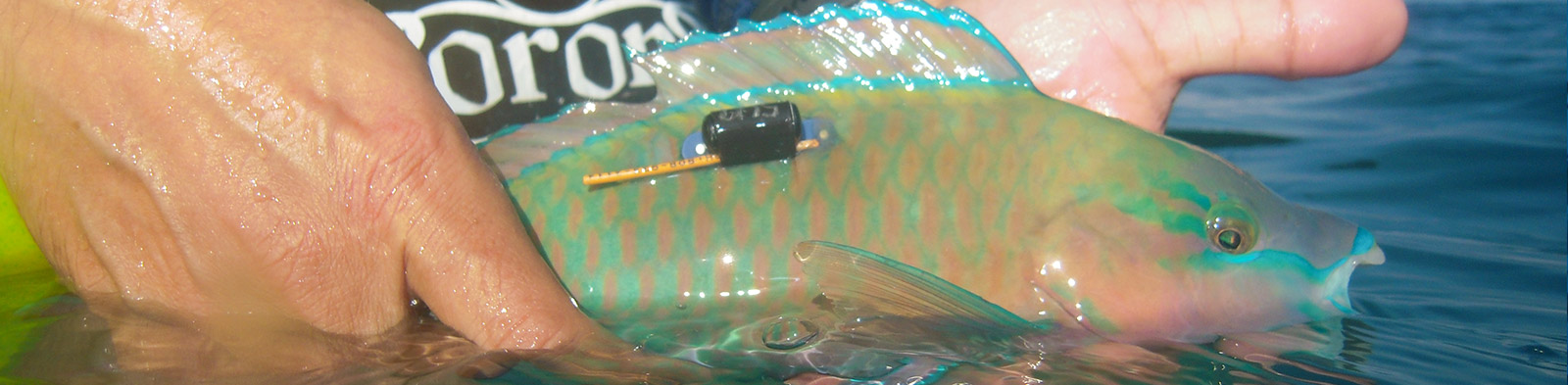
We are collaborating with researchers at the University of Hawaii-Hilo to examine habitat use and connectivity for two species of parrotfish at both healthy and degraded coral reefs off the northwest coast of Hawaii (Puako, HI) using acoustic telemetry. A VR2W positioning system (VPS) is being used in conjunction with detailed habitat maps to investigate fine-scale (spatial resolution <3 meters) movement patterns of palenose (Scarus psittacus) and red lip (Scarus rubroviolaceus) parrotfish across coral reef seascapes. The goal of this study is to characterize species-specific patterns of habitat use across temporal cycles (e.g. tidal, diel) at both degraded and healthy reefs to determine how reef health affects habitat connectivity in Hawaiian parrotfish.
Associated Publications
Annandale SF, Turner JT, Lippi DL, Dance MA, Wells RJD, Rooker JR (2024) Habitat use and movements of parrotfishes in a Hawaiian coral reef seascape. Frontiers in Fish Science 2:1448809. doi.org/10.3389/frish.2024.1448809